Linux Audio Development (LAD)
Punk Labs
Linux Audio developer interview with Oren and Tara from Punk Labs
This interview was conducted by Amadeus Paulussen in 2025.

Dear Oren and Tara, Thank you so much for taking the time for this interview—I really appreciate it. 🙂
To start, could you share a bit of background with us? Specifically: 1. Where does the name of your company, Punk Labs, come from, and what does it mean to you? 2. Could you briefly introduce yourselves?
Tara: Hi Amadeus! Thanks for giving us a bit of space to talk about Punk Labs and audio plugin development. I'm Tara, AKA Skunkie. And full disclosure, we're not only business partners but life partners too 🥰.
Oren: Hey, I'm Oren, AKA PolyVector. The name Punk Labs mostly speaks to our approach to everything we make. We create what inspire us, do what we want, and aren't too concerned with how it's received.
Next, I’m curious about what led you to start a company where you seem free to explore and create whatever you like—which at the moment, happens to be a bunch of really cool audio plugins. 😎
Tara: Really, we knew the moment we stepped out of high school we didn't want to just fall into a soul crushing job. It just kinda happened this way because of who we are. We're willing to live simply and love to make things!
Oren: What she said!
If I am right, you’ve developed for game consoles, desktop operating systems, and embedded devices. Was Linux (in addition to macOS and Windows) something you supported from the very beginning, or did you add it later on?
Oren: In the beginning our projects didn't support Linux because we didn't have enough knowledge or experience with it as a platform. However, since switching our personal machines over to Linux, we've felt confident enough to support it.
Tara: Cross-platform software has become much easier to develop with all the new frameworks and languages like Rust and Go.
It seems like you split your work at Punk Labs roughly 50/50. Can you tell us how you divide responsibilities and which tasks tend to take up the largest portion of your work?
Tara: I typically take care of our development pipeline, which also entails setting up virtual machines and KVMs for building and testing our plugins. I also write the documentation and manage store pages and press releases.
Oren: I mostly do the programming, and some graphic design here and there.
Which operating system do you primarily use for your work, and if it’s Linux, could you tell us a bit about your preferred distributions, desktop environments, and / or window managers?
Oren: We've been using Linux primarily for some time now, and have tried a number of different distros. We've settled on Arch as our favorite distro, it's a great combination of always-up-to-date, stable, and customizable.
Tara: I've always been a huge GNOME fan. It's clean and simple. It stays out of the way. I will say that COSMIC has piqued my interest. If I had more time right now, I'd love to install it and take it for a real spin.
What do you think motivates people to choose Linux as their main operating system?
Oren: How much time do you have? Privacy, security, control, compatibility, transparency, ownership. And that's the thing, people choose Linux. Hardly anyone chooses a proprietary operating system, they just come pre-installed.
Tara: Exactly right! Or it's what they learn in school. Most people don't get any kind of experience with Linux until college. That is Apple and Google's entire plan, catch them while their young. But I digress.
Do your audio plugins rely on a particular framework? If so, which one, and why did you choose it?
Oren: We're using NIH-plug at the moment, and I'm a huge fan. We switched to Rust as our programming language a few years ago, and it's really the best framework in that ecosystem. I find Rust to be a very memory-safe language. While not perfect, it does help you avoid many common pitfalls when dealing with memory allocation and pointers. I should also mention that we write all our DSP in Faust, which allows us to take our DSP to other languages/frameworks with relative ease.
Tara: Rust and NIH-plug make cross-platform development and building insanely easy as well.
How much direct interaction have you had with the Linux audio stack (ALSA, PipeWire, JACK)? Do you rely on a framework to abstract these layers?
Oren: Honestly, all of this is abstracted away by NIH-plug and the DAWs that host our plugins. Most of my experience with PipeWire is as a user who likes to wire up things in helvum.
Have X11 or Wayland caused any particular challenges when developing your Linux builds?
Oren: While we shouldn't deal directly with windowing, the differences with X11 and Wayland have caused a few small hickups regarding compatibility between Baseview (the part of NIH-plug that handles windowing) and some specific DAWs. Usually these things are quickly resolved upstream, but occasionally we have to work around a tricky windowing issue.
What do you think about installers and/or install scripts? And do you think Flatpak could eventually become a standard on Linux that can also be used to install plugins?
Tara: Personally, for plugins I find installers more trouble than they're worth. But, I am coming at this from a place where I understand each platform's file structure and where DAWs are looking by default for plugins. It is quite common for people to not know where to put their plugins, this is a big reason we provide both an installer and loose plugins. Let the user decide. I don't think Flatpak will be a standard for general plugin installation, due to the sandboxed nature, but it will be for any DAW being distributed as a Flatpak.
In addition to VST3, you also support CLAP. What are your thoughts on this emerging format?
Oren: In my opinion, CLAP is the best plugin format we have. It supports things like MIDI 2.0 and polyphonic modulation, and no single company controls it. I would love to see CLAP more widely supported by DAWs and plugin frameworks.
What’s your perspective on Steinberg making the VST3 SDK Open Source?
Oren: When we started developing audio plugins, the VST3 SDK was dual-licensed under GPLv3 or a Steinberg proprietary license. Since our plugins are Open Source, the GPLv3 license worked out well for us. However, if we had wanted to sell closed source software, their proprietary license would have been somewhat restrictive. I think it's wonderful that they've switched to the permissive MIT license, as this will give developers more freedom to choose how they create and distribute audio software.
How do you handle copy protection in your plugins?
Tara: Our plugins have no DRM (Digital Rights Management). You can choose to compile them yourself with no restrictions, and/or purchase a built binary and support further development.
Is the code of your plugins mostly platform-agnostic, or do you often have to implement custom workarounds, or hacks for different platforms?
Tara: Mostly the code is platform agnostic, there has been the rare fix here and there. Mostly for windowing on different platforms.
And, how does this work in relation to DAWs? Do you sometimes need to do custom work for specific DAWs?
Oren: Usually we don't write code for specific DAWs, but we may fix a bug that only appears in one or two DAWs in a general way. The plugin framework we use, however, probably has many subtle fixes for specific DAWs, but I couldn't really speak to that.
What are your thoughts on subscription-based or “rent-to-own” models for plugins?
Oren: If software is a service, we should all start tipping our computers. If it's not a service, we should be upset with the idea of being continually charged. Artificial scarcity is probably one of the stupidest things humanity has dreamed up. I don't know about Rent-to-own, but it sounds like a way to eek money out of people who don't have it.
Tara: Sadly, there is a whole generation that will only know the subscription model. I find that most companies are more than willing to take your money and not listen to feedback with these types of models. Innovation stagnates. It's also not sustainable for people. People can't (and shouldn't) pay indefinitely for every plugin they use.
Is Itch your preferred distribution method for any particular reason?
Oren: Itch doesn't try to micromanage everything on their store, or impose arbitrary censorship. We became fed up with Apple demanding this or that before they would delete our software forever and prevent new users from downloading it. I personally feel that they act like a mafia. Hopefully they don't read that and kill our plugins on macOS, which they could do by revoking signing certificates, it's basically a sword of Damocles.
Do you contribute to Open Source projects, and what motivated you to make your own plugins Open Source?
Tara: We haven't contributed much code to other Open Source projects, but have done bug reports. We've always wanted to contribute more, but confidence kind of got in the way. Open sourcing our own projects was mostly about longevity. We've had games get removed from stores on platforms where that is the only distribution method. Making the game essentially disappear. We didn't want that to happen to any project going forward. People should be able to use our software years from now even if development stops.
I keep hearing that Open Source is difficult to sustain as a business model. What is your experience?
Oren: Free and open technology is like science and mathematics; it should belong to the people as it moves society forward. If your goal is to make the most money, then sure, Open Source might be more difficult. I would say it's still a good idea to Open Source anything you are comfortable with, it doesn't have to be all-or-nothing.
Tara: Open Source is the last bastion of innovation. Truly collaborative and a space for diverse ideas. If your product is treated like any other propriety option, marketed and pushed with the same enthusiasm, there is no reason it can't succeed and be better than the competition. Don't forget that propriety products get venture capitalist money, loans, and the like. Open Source has its own benefits in the possibility for grants to help kick start development.
What do you see as the biggest challenges in developing plugins in general, and are there any specific challenges when developing for Linux?
Oren: If you have a solid framework and grasp of programming, then the biggest challenge is learning enough about DSP to be able to create something interesting. Some concepts like subtractive synthesis are pretty intuitive, while physical modeling and other concepts are much more difficult. The primary challenge when developing plugins for Linux specifically is there's no universal foolproof way to distribute.
What advice would you give to developers who already offer plugins for macOS and/or Windows when deciding whether to support Linux?
Oren: If you can do it, just do it. Linux users tend to be super helpful and knowledgeable, and will probably help you fix any issues that arise.
How important do you think user experience is for a plugin’s success?
Oren: UX is critical, otherwise users would just turn off the UI and use the generic list of sliders the DAW provides. People should have fun using a plugin, or I imagine they won't keep using it.
And how crucial would you say marketing is for a plugin to succeed in today’s crowded music production market?
Tara: Marketing is everything, and we're terrible at it. We'd rather be coding than spending time on ads, posting on social media or working with influencers.
By the way: Do you make music yourselves, and if so, which three tracks would you say best represent your style?
Oren: I write some music, mostly for our game soundtracks. I don't really know what you'd call my style, and I'm not sure I want to know.
I post music on Arghitect.com and these tracks might give an idea of my more recent sound:
A completely different topic: How do you see AI influencing music production (and the development of music production tools) in the future? Is AI already playing a role in your work today?
Oren: I personally love tinkering with local music models. Despite the reputation for slop, AI can be super inspiring when you treat it like a glitchcore instrument and write inference code to generate cursed sounds and music. I have a hacked up MPC One that I pipe this stuff into, it's pretty fun. As for development, AI has helped us translate our website, write build scripts, create plugin presets, etc. Programming is rapidly going the way of assembly and punch cards, and I'm all for it.
In the future, my hope is that AI will automate soul-crushing work, corporate art, and low-effort pop music, and do it in a way that doesn't leave us all starving and homeless. In that world we could create for the sake of creation, make art for the sake of art, and do the things that truly inspire us. Maybe AI will help us appreciate our humanity more, but I'm an optimist.
Can you share any plans you have for the future? 😜
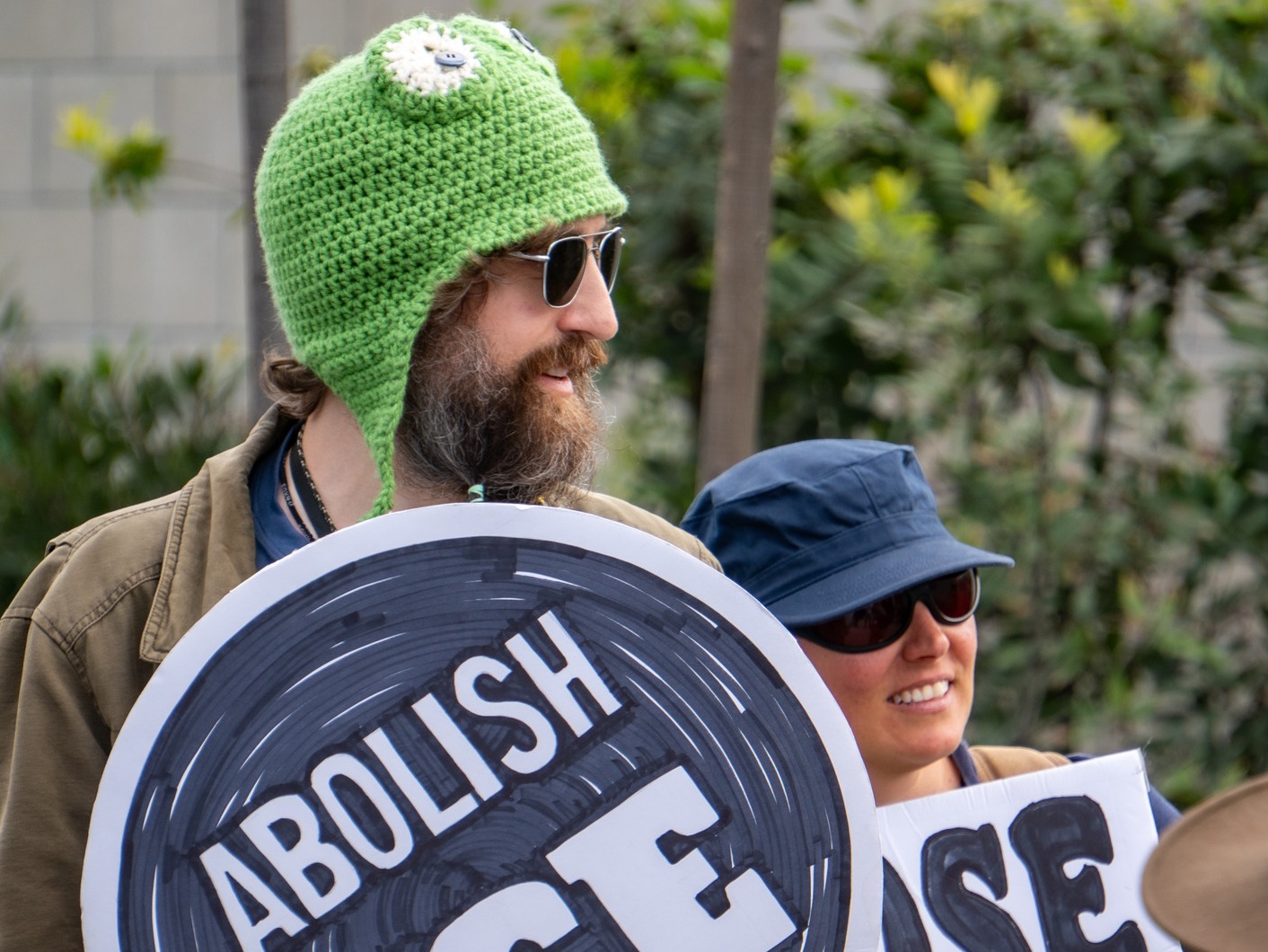
Tara: The future is so up in the air right now for us. We love creating software, but currently our lives are dedicated to activism and resisting fascism in the United States. We're hoping after this mess is done, we can get back to development.
Oren: Yeah, I can't see past next week for us at the moment. Life is completely exhausting, and I haven't written a single line of code for Punk Labs in the last year.
Finally, is there anything else you’d like to add?
Tara: We're all so used to sitting comfortably at our computers. Don't forget about the community right outside your door. Be kind. Be the change you want to see in the World.
Oren: No ICE, No KKK, No Fascist USA!