Linux Audio Development (LAD)
Signal Perspective
Linux Audio developer interview with Giorgio Presti from Signal Perspective
This interview was conducted by Amadeus Paulussen in 2025.

Dear Giorgio, It is my pleasure to interview you. Thank you for taking the time to do this. 🙌
To begin, could you introduce yourself and give us an overview of your artistic and technical work? You seem to be active in many areas—audio, visual art, culture, and even science—so an introduction in your own words would be wonderful.
Oh gosh, that's a tough question... My interdisciplinarity is more a reflection of my mental confusion, rather than a deliberate path! I can say that I've always been attracted to science and other creative expressions (such as music, imaging, coding), and I've been lucky enough to find a way to explore those things. I studied computer science in high school, worked in an audio mastering and DVD authoring studio, and in a graphic design studio. Then, I studied Sound and Music Computing at university, where I also got a PhD in Computer Science.
Alongside these "official" occupations, I've been playing in bands and creating sound art installations in my city (things that allowed me to dig into artistic disciplines). From the outside, it may seem that I do many different things, but to me, they are just different aspects of "something" I still can't really define.
Developing audio tools is a way to express creative ideas, to build tools I need, or to learn things. The same can be said for my artistic production: it has a pedagogical goal, a psychological goal, and a pragmatic (social) goal. My (musical and visual) taste is oriented towards noisy stuff, errors, glitches. I think it's because these things are usually overlooked by most people, but there is information there (about the environment, about the inner workings of devices, and so on), just information people are usually not interested in... But I am. I am always interested in what's under the hood, I love to try new aesthetic criteria, and I agree with whoever said that "Noise is a manifestation of truth". Did I answer, or did I derail completely??
Your music strikes me as multifaceted, experimental, and rich in detail, yet stylistically diverse. If someone wanted a good starting point, which five tracks of yours best represent the breadth of your musical work?
Well, keep in mind that everything you can find online is 20-year-old material (but I'm releasing new stuff at the beginning of next year!). Anyway, if you ask me, I would suggest the following:
- Son of Noise—Confusion
- Son of Noise—Perseverance (Die Schlüssel)
- Giorgio Presti—Parte di me
- Giorgio Presti—Emercor
- Giorgio Presti—Alba
- Giorgio Presti—Inarmonico I collected them in a playlist: Youtube, Spotify
How did you first get into plugin development? Was it something that grew naturally out of your artistic work, or did it begin as a separate interest?
Since the beginning of my interest in music production, I've always wanted to create my own instruments. As I said earlier, I feel it's part of the artistic process.
At first, it was just scripting inside an old piece of software called Goldwave. Then, I discovered Reaktor and MaxMSP, but I felt the need to go more 'low level', so I looked for templates to build VST plugins in Delphi (I knew Pascal from high school, where I had a passion for demo coding), and then I switched to C++.
So, yes, the "urge" has always been present, but the approach to the plugin format has been more gradual.
When developing plugins, do you handle everything yourself—concept, UI/UX, coding—or do you collaborate with others?
The ones released under Signal Perspective are 100% me. Trailbender started as a pedagogical tool for my students, and as an exercise for me to experiment with a complete product design pipeline. Grindbox was born as an exercise to learn JUCE, and I developed Pyrite to learn virtual analog modeling.
The process is usually the following: I have a need or an idea for a tool, I prototype it, and play/use/improve the prototype until it is mature enough. Then, I decide whether to turn it into a plugin or leave it as an "internal use" tool. If I decide to turn it into a plugin (that is, if the idea is mature enough, and I think it may help someone other than me), I start the actual effort to create something stable and usable.
However, other plugins (those available at audioplugins.lim.di.unimi.it, which will be updated soon with a lot of new stuff) are the result of the work of my students. In most of those cases, I just had a supervising role, but some are actual collaborations.
What tools, languages, or frameworks do you rely on when developing your plugins?
The main framework I use is JUCE/C++ in Visual Studio. I also use prototyping tools, such as Python and MATLAB, for the DSP part, but I think it's worth mentioning that my preferred design tool is the good old pencil and paper.
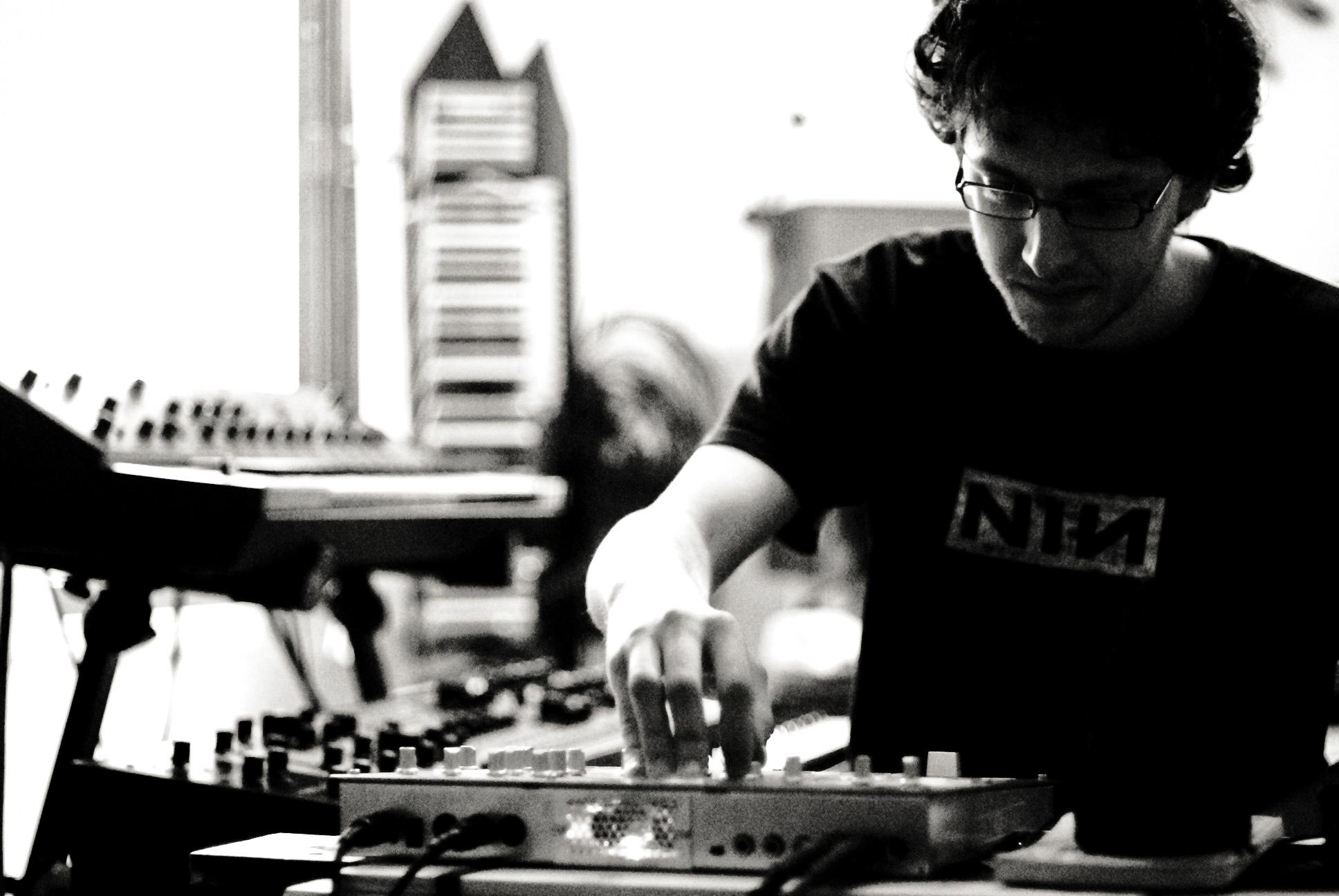
Could you perhaps give us an idea of your workspace or studio setup?
OK, thanks for asking! Now I'm forced to tidy it up for the pic 😆!
I've changed my setup many times, but the devices inside the studio don't change that much. Fortunately, I'm not affected by G.A.S. (editor's note: Gear Acquisition Syndrome): I prefer to master a device before buying new stuff, and I buy stuff only when I really need it because I'm not exactly swimming in money.
I have some synths, a groovebox, some circuit-bent toys, controllers, mics, sounding objects, patchbays, stompboxes... The usual stuff you would imagine when thinking of a noise musician. 😅
Have your plugins supported macOS, Windows, and Linux from the beginning, or did you expand to additional platforms over time?
Well, at the VERY beginning (the Delphi era), it was just Windows, but there was nothing fancy to distribute. Nowadays (the JUCE era), I started with Windows and Mac, but I immediately added Linux to the list. There was no reason to exclude it.
If you use JUCE the right way, compiling for all platforms is a very simple task (well, sometimes I run into issues with Xcode, but nothing that can't be solved in less than an hour or two... plus a few F-words!).
You offer your plugins as donationware. Could you share the reasoning behind that decision, and how well the model works for you in practice?
At first, I thought I would just let people download them for free, but then I opted for a way to let them donate something—both to suggest that maybe the plugins are worth something, and to get a little tip if someone wanted to contribute.
How well has it worked? After 25,910 downloads, I got 18 donations, averaging about 10€ each. Since I wanted to release them for free, I consider it a positive result; it basically covers the hosting costs.
But, at the same time, it makes me think. I know what it takes to develop good software: it takes a lot of time. That's why I try to avoid piracy when prices are honest. I regularly donate to Wikipedia, and I donate each time I find donationware that I use. Finding out that less than 1% of users share my perspective is a bit sad.
Have you ever considered making your plugins Open Source? And what are the arguments for or against it, from your perspective?
Actually, some are Open Source (e.g., many plugins from my students, my test signal generator, and all the non-plugins on my website). Only the "flagship" plugins are closed source.
It's a gut choice, probably because sometimes I'm not really proud of the code, and other times, because I want a backup plan in case I want to seriously monetize my software (something that is not on the horizon so far). I don't rule out open-sourcing everything in the future.
What operating system and desktop environment/window manager do you use for your non-development (music production and artistic) projects?
It might disappoint you, but I'm a Windows user. I code and make music on Windows (I compile for Mac and Linux using CI/CD actions on GitHub).
However, sometimes I use the Linux shell to work on our servers—for example, to host web services, or to run machine learning stuff.
As both an artist and a plugin developer, how do you perceive today’s music market? And how do you handle the challenge of visibility in such a crowded landscape?
I think the landscape is saturated, and I don't care about visibility. The market is filled with redundant, frequently useless, and largely overpriced stuff. I don't want to contribute to that.
The only places where I share my releases are Gearspace and KVR, but always in a humble and quiet way: "I made this tool for me, go check it out if you think it might help you too." Some YouTubers and blogs echo the news (and I'm really glad and honored for that!), but it's not at my request.
The same goes for my music and for my art installations. I'm not doing these things for money (but, you know, if someone wants to drop a few bucks, it's always welcome 😆).
Don't get me started on the AI topic: It can be a wonderful technology, but the "AI slop" is a side product that is definitely not helping the situation.
I often daydream of a world where all things—not just software—are Open Source, yet we seem to be heading toward more subscription-based models. What are your thoughts on this?
I hate subscription models, and I agree with you about the "Open Source everything" idea, at least ideologically... but in practice, I'm not really involved in the Open Source community... I mean, the only times I'm interested in looking at the source code are when the documentation sucks.
Might I ask if you earn your living mainly through music, art, and plugin development, or do you perhaps have a separate job alongside these pursuits?
Currently, I'm a researcher at the University of Milan, in the Laboratory of Music Informatics.
I also teach two courses there for the Bachelor's degree in "Informatica Musicale" (aka "Sound and Music Computing"). One is called 'Development of Music Production Technologies', where I teach how to write plugins with JUCE/C++. The other is 'Artificial Intelligence for Music (Computational Creativity module)', where I cover the history of generative arts and introduce modern approaches to generative AI.
I've been working in academia since I finished my PhD in 2017.
From your experience, what are the biggest hurdles in plugin development? And are there perhaps any challenges unique to Linux?
I've never had trouble with Linux. macOS is the real pain. But, aside from that, I don't perceive anything as a hurdle in the process; I enjoy every DSP or C++ challenge I take on. However, if you ask me for advice for those who want to start this endeavor, I'd say that (professional) plugin development rests on four pillars: Math/DSP, Programming/C++, UX Design, and Ear Training/Production Experience.
How do you see Linux evolving as a platform for music and multimedia production in the future?
I'm definitely not an expert on Linux. I hope it takes off as a massively adopted music production environment, but I have absolutely no idea how that could happen. Maybe websites like this one can help!
And finally, I’d like to give you the last word. Is there anything else you’d like to share with the readers?
Not really, I think I've talked enough! Stay curious, support indie devs and artists, and forgive me: In the end, I didn't tidy up my studio and just sent an old photo. 😅