Linux Audio Development (LAD)
Morten Mosgaard
Linux Audio Artist Interview with Morten Mosgaard

Dear Morten, thank you very much for agreeing to do an interview for Linux Audio Development. 🙌
You work for the Danish Chamber Orchestra Ensemble MidtVest, are a composer and sound designer, as well as a vocalist. Could you start by briefly introducing yourself and describing your artistic work?
Sure, and first of all, thank you so much for reaching out. I’ve been following your work with Linux Audio Development for some time, so I’m very thankful to be able to contribute.
Originally, I have a bachelor’s degree from the Royal Academy of Music in Aalborg, Denmark, where I studied contemporary vocals and music for children. Since then, I’ve worked mostly freelance—as a vocalist, songwriter, and cultural entrepreneur—but also applied the pedagogical side of my education. I worked at different schools before transitioning into leadership and administration, serving as a school principal for several years.
While studying, I was the kind of student who had all kinds of projects on the side: a jazz combo, a concert concept for children, a free-jazz club, a collaboration with actors from the local theater, and so on. So my artistic career has always pointed in many directions—until I quit my role as principal and co-founded a theater in 2019 with my partner and another couple. The whole idea was to create a professional theater that could coexist with raising kids and building a financially sustainable artistic career. In the theater, I was the administrative lead and sound/music person—and since my partner is an actress, it felt natural for me to shift more into sound design and composing, so we wouldn’t both have to tour, and one of us could stay home with the kids. That’s how I ended up moving from being a songwriter and vocalist to focusing more on sound design and composition.
As some may have guessed, the family- and financially sustainable theater was something of an artistic utopia—one that ultimately led me to my current role as Head of Office at our local chamber orchestra in Herning. At the orchestra, my main responsibility is cultural administration, and I pursue my own artistic work in my spare time.
If someone wanted to get a good overall sense of your work, which three projects would you recommend they watch or listen to?
All my projects in recent years have been very much focused on exploring what “site-specific” means for sound design and composition—while also incorporating what we in the theater called “social-specific”: working with relations between the artists and the people living in the places where the art projects are based. One example is the Audio theater version of our play Everything is a Dinosaur, where all sounds in the original play were sampled from sticks and rocks collected by kids during workshops—which I then turned into instrument sounds and sound effects.
Another is Sounds of Stadil-Vedersø, where I made field recordings in two rural villages, turned them into free LoFi-ish sample packs, and—with sponsorship from the local municipality—provided MIDI keyboards to young aspiring music producers from those villages, so I could teach them to create their first tracks using sounds from their own communities.
And last but not least, I’d recommend watching the short doc about The Dancer Revisiting—a project where I had dancers improvise with kids in kindergartens, then brought them into an art gallery in a forest to improvise with a jazz orchestra. I’m usually very focused on connecting elements I haven’t seen linked before—and The Dancer Revisiting is a good example of how this sometimes becomes less about my own artistic work, and more about creating a collective artistic experience for everyone involved.
What is your relationship with computers? How did you first start using them creatively, and what have been the major stages of that journey?
I was born in the 80s in a house with a computer—a Commodore 64—so I’ve had computers in my life since I was a kid. My father was always great at sharing what I could do with them. In my teens, I started programming, building websites, and making my first very basic recordings in Wavelab (one track, just overdubbing). So I’ve always had an interest in computers—and when I started the theater, that interest merged with my ambition to find new ways of expressing myself musically. It became this really nice, geeky adventure: using mostly found sounds for music production and sound design—you know, watching the world as my oscillator, and throwing everything I could into a wide range of effects and samplers.
Why Linux? What motivated you to explore this Open Source ecosystem as an alternative platform?
When I started working at the Chamber Orchestra, I had to scale back on my artistic projects—which ultimately meant I no longer needed to continually produce in my studio. Combined with a growing concern about the lack of autonomy in digital systems—like not being able to use an Apple or Windows computer without creating an account tied to centralized servers, whose locations I can’t control—I began seriously considering what alternatives existed for me as a sound designer and composer. Since I was already active on Mastodon, I started following hashtags and people working with #Linux and #LinuxAudio—one of them being you—and slowly found the courage to make the move.
Which Linux distributions and desktop environments have you tried so far, and where have you landed today?
I found the Irish distribution Zorin as one of the first I tried, since I was looking for something not too far from what I was used to on my Mac. Zorin is a really great first distro—with plenty of guides, easy desktop customization, and smart approaches to making Linux more accessible for newcomers. I was up and running in no time, and actually really happy with what I had. But as I kept running into different audio-related issues—with settings, drivers, software compatibility—I went “distro hopping,” as they say. I tried Ubuntu Studio, Linux Mint, Pop!_OS, Bazzite, and more, each with different desktop environments. I ended up on CachyOS—an Arch-based distro—with GNOME as my desktop environment (the same one I started with on Zorin). CachyOS felt a little too command-line heavy at first, but the performance boost on my laptop was so noticeable that I decided to stick with it—and learn just enough to make everything work. Turns out, it was way easier than I expected.
A funny side note: my main problem on Zorin turned out to be my DAW at the time—Studio One—which was still in beta for Linux. Once I switched to Bitwig (which has supported Linux for a long time), everything got a lot easier.
Can you tell us a bit about the equipment you use with Linux (audio interfaces, controllers, instruments, etc.)?
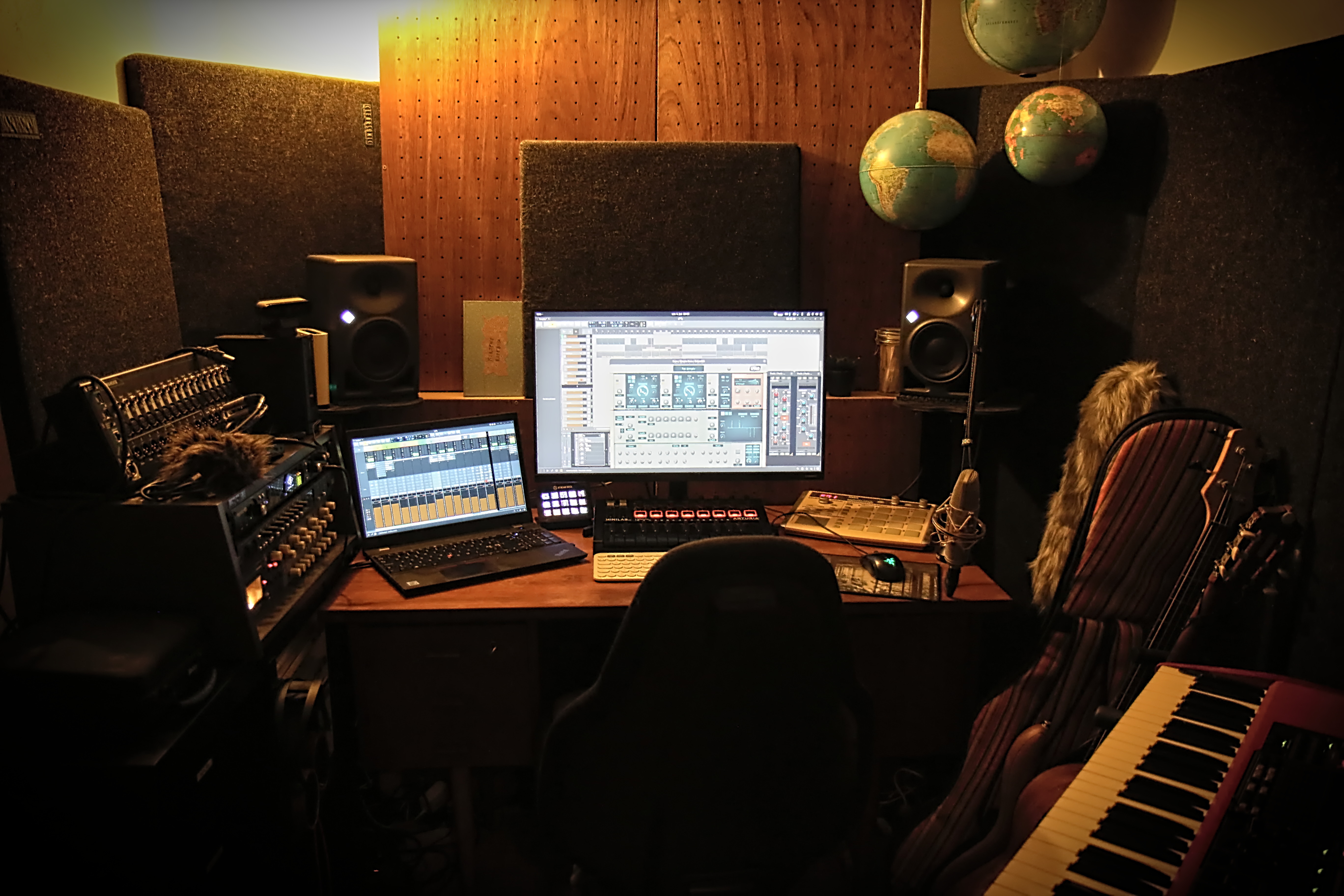
I started by buying a new laptop, a second-hand Lenovo, for €550, from a local guy who refurbishes office machines. My intention was actually just to test Linux and see if I could make it work for music production. Turns out, it works just fine—which is kind of crazy, because the price of that used Lenovo was about ⅛ the price of my MacBook.
Since it all began as an experiment, I’ve stuck with the same gear I used on my MacBook—and so far, everything works. The only exception is my Universal Audio interfaces (Apollo 8P and Twin) which do not support Linux. Luckily, my two Zoom field recorders (H6 and F3), which are both class-compliant audio interfaces, work perfectly. My MIDI devices, Arturia MiniLab and Korg PadControl, also worked out of the box. The PadControl has a MIDI in and out, so I can connect any additional MIDI through that, like my electrical piano or my Akai Force hardware sampler.
Since my monitors were originally connected to the Apollo, I now run a line-in from the Zoom recorders, so I can still use the volume knob and monitor switch on the Apollo. It’s the most expensive monitor controller I’ve ever owned 😊
One day, I might sell my UAD setup and look for a different audio interface—but honestly, it’s not a pressing need right now. Of course, the preamps in the Zoom recorders are completely different from the Apollo’s, and I’ve had to get used to not having the UA software mixer for low-latency monitoring. But for most of the projects I do, it’s not an issue—since I mostly work with field recordings. If I need to record vocals, I have a Focusrite hardware channel strip I can plug my mic into, and I’ve created a low-latency template with resource-efficient plug-ins, so I can use software monitoring through Bitwig.
From an artist’s perspective, which aspects of using Linux perhaps still cause you headaches?
I won’t say I have headaches anymore. Bitwig on Linux is more stable than I’m used to—both Studio One and Ableton on macOS (though instability there was often plugin-related too). I’ve found a great set of plugins I like to use, and I’ve actually started to laugh a little at my old “this preamp is all I need” craze from my UAD days. When you can grab new plugins on sale that “do it just right,” you tend to forget what you already have. Moving to Linux has motivated me to focus on the hardware and software I already own, rather than always chasing the next thing.
That said, when it comes to plugins, it's essential to find a collection of Linux native plugins if you’re coming from macOS like I did. You can get some Windows versions of plugins working via Wine and yabridge—but it takes effort, and it’s not stable enough to rely on for all the tools you know from Windows or macOS.
What would be a Linux Audio dream come true? What would need to happen to make Linux an even better platform for music production and work around the creative arts?
To me personally, I’d love to be able to use the plugins and audio interfaces I already have. Since I have a UAD setup in the studio, that would be my biggest dream—not because UAD is the best on the market, but because it’s what I already own, and I’m generally very satisfied with it. I really hope more vendors turn to Linux soon—and I can’t really see why they wouldn’t. My choice of audio interface shouldn’t decide which mega-tech company I’m forced to share my data with. Supporting Linux could change that.
For others—especially artistic people not used to installing packages or digging through rare settings—I wish Linux were easier to access. The barrier shouldn’t be technical experience, but artistic intent.
Do you know many other artists who use Linux in their work?
There’s no one in my immediate network here in Denmark, so I don’t really have anyone locally to share my experience with. Luckily, the #LinuxAudio community on the Fediverse seems to grow every week—that’s where I share my experience with music production on Linux and meet other artists doing the same. It’s incredibly valuable to have such a community.
Would you recommend other artists to use Linux as the centerpiece for their art, and if so, what tips would you give them to start their Linux journey?
Yes! And no. It takes work to adapt to Linux and music production is still not “plug and play,” especially if you’re starting from scratch. But I see plenty of reasons to make the switch, so I really hope more artists will put in the work and engage with the community. I’ve been active in the forum of the distro I’m using, and some of the questions I ask are new, because not many people are using it for music production. Just being visible, vocal, and honest about your problems and discoveries can make a real difference.
Has Linux ever been an obstacle—or perhaps even an advantage—when collaborating with other artists?
I don’t really collaborate in a way where I need to send app-specific projects to anyone. So, no.
Do you feel that using Linux has influenced your artistic identity or working methods in any way?
If you look at it from the outside, I don’t know if people will notice it has influenced my artistic identity or working methods, since the output of my work is the same.
Internally, though, I’ve noticed two rather big changes.
-
The biggest change has definitely been my renewed focus on using what I already have—rather than always chasing new gear or plugins I don’t own. I’ve been working with music for 20 years, so I’ve accumulated quite a collection of tools I’m now really looking forward to revisiting. On my list: testing old FireWire audio interfaces—which haven’t been supported on macOS for years. I have no idea if it’s possible, but Linux seems like the right place to try something like that!
-
I also notice a new tendency to engage more with the community—reaching out to vendors to encourage Linux support, discovering and exploring different Linux audio development projects, and wanting to support these initiatives. Where this is going, I don’t know—but it’s far more exciting to help create opportunities for all of us working with music production on Linux than to just buy another plugin on sale.
Would you agree that the infamous Linux fragmentation is both a blessing and a curse?
Yes indeed. Personally, I’ve really enjoyed finding the distribution I’m using and exploring what different projects focus on. But it takes time and dedication to test different distros and figure out what matters to you in one. Do you need Flatpak? Is it a problem if installing AppImages or .deb packages (editor's note: A software installer format used by Debian-based Linux systems) is tricky, especially if you don’t yet know what any of these things are?
What are your thoughts on the developments surrounding the replacement of X.org by Wayland or that of JACK/PulseAudio by PipeWire?
My technical understanding of all this is really limited, so my main impression, as a new Linux user, is that it’s been one of the hardest things to wrap my head around. I’m afraid it might keep people from jumping to Linux, since it can quickly feel “too techy” for most.
Personally, my feeling that Linux could actually work for music production came when I started using Bitwig with PipeWire. Before that, I tried different setups with JACK/PulseAudio, and it really didn’t work for me. It was hard to get started, and even harder to understand the basics—like, how do I change the sample rate when my DAW doesn’t seem to let me? PipeWire isn’t exactly simple either—but Bitwig (and an Arch Linux audio guide) handled most of it for me.
So my main thought is: we can’t move to (Wayland and) PipeWire fast enough, so more people can get an easier, well-functioning Linux machine out of the box. But again this is said by someone who doesn’t understand the tech part of this discussion.
Do you use Flatpaks?
Very limited—but I really like the idea of an app store like that. CachyOS has its own repository, so I normally go there first—then to the Arch Linux repo, then Flatpak, and lastly AppImages or .deb packages if that’s all I can find. I install everything from the command line.
You recently approached me with a great idea for promoting the Linux Audio Development Initiative and immediately started working hand in hand with me to implement it. How important was the Linux audio community to you on your journey to becoming a Linux artist?
I think the number of times I’ve mentioned it already speaks for itself. It has been so valuable to me to read about others, ask questions, get inspired, and just feel less alone in the process. I’d also mention the whole Linux community on Mastodon. I can’t remember writing a post with the #Linux hashtag where I didn’t get a reply I could actually use. People have been so generous on this journey and I really want to give back.
At the same time, I think working with audio on Linux is already very good, but it can be better. It should be easier to get started, more plugins should be available, and more audio interfaces supported. And it feels like this is the right time to make that happen.
What do you think should be the next steps for the Linux Audio Development Initiative?
I’m already deeply impressed by all the work that’s been done so far—the Linux vendors list, FAQs, interviews with developers and artists, the requested vendors list, and more. I really think it’s already made an impact—and will continue to do so with its current direction. I do think the project would stand stronger, if it was more clear, that there is many out there for whom music production on Linux is valuable. A way to support that narrative could be to create an advisory board.
Do you have any thoughts on Open Source vs. proprietary software?
I was educated in the 2000s, back when DIY (Do It Yourself) and Creative Commons were the talk of the town. I remember a lot of artistic projects back then being released by the artists themselves, with a very open approach to ownership. It was really exciting to see, but from my experience, it wasn’t a complete success for supporting an artistic career.
I see this as related to what we see with Open Source today. Open Source has so many benefits for society as a whole, sharing knowledge, co-creation, transparency—but it’s hard to turn into a sustainable business, which most people need if they’re to keep focusing on development.
What I’m trying to say is: I really understand why developers choose the proprietary route, and opt for a more business-minded model. But what I do hope is that more companies and developers choosing that path will be better at reaching out—asking for help, collaborating—so they can start supporting Linux.
Can you name us your favorite Linux creative tools at the moment?
Well—since I spend most of my time in Bitwig, that’s the clear number one. But I also really like how easy it is to route audio between inputs, outputs, effects, and different software—especially in Carla.
Which products/vendors would you like to get Linux support next?
I’d like to be able to use my UAD audio interfaces—so I don’t have to go through the “sell and buy” process. Interfaces first, then Arturia, FabFilter, and UAD plugins next—since those were my most-used plugins on macOS.
Are you generally concerned about humanity's artistic output in the emerging age of AI?
It’s hard to address without sounding like a complete arrogant asshole—because it leads us to talk about artistic quality, and what can even be considered art. 😊
I believe most artists become artists because they have a deep desire to create themselves, which makes GenAI less attractive as a tool. I’m pretty sure these people will find a way to express themselves artistically, even if others start using GenAI.
But there have always been people who couldn’t care less whether what they create is artistically interesting or rewarding—all they want is the next hit, fame, views, etc. These people have always wanted to do whatever it takes to succeed—which, I find, isn’t rooted in the artistic work itself, but in the attention they get.
In that space, I think GenAI will make a splash for a while. I am concerned about the whole AI craze—but mostly because of the dynamics it creates in our society, the environmental impact and how it influences our economy as a whole. I feel too many companies lack the ethical considerations that should always be part of technological development—but rarely are.
Would you like to address anything else?
I’d just like to once again express my deepest respect for the huge work you’ve done with Linux Audio Development—and I’m really looking forward to seeing where this all goes.